
The complete guide
How To Choose An Outdoor Cat House That Your Cat Will Actually Use
The problem with "they'll find somewhere"
Most cats who spend time outside do find somewhere. The trouble is that somewhere is usually under a car, behind a shed or wedged under the decking where you cannot reach them. Those spots are fine in good weather and miserable in bad weather, and you have no say in any of it.
An outdoor cat house changes that. You choose the spot, you can see whether it is dry, and you know where to look for your cat when the wind picks up.
The cat does not care about your reasoning. It wants to know whether the place is dry, whether it is out of the wind, and whether it can get out fast if something comes along.
What makes an outdoor shelter work
Start with the shell. This house is soft-sided, with a heavy denier polyester exterior that the supplier lists as water resistant. That is a different thing from a shelter you can leave in the open in a downpour. Treat it as a house for a covered spot.
Then the insulation. The walls and roof are insulated. No R-value or temperature rating is listed, so we cannot tell you what kind of night it suits. Insulation also does not make heat. This house is unheated and has no electrics.
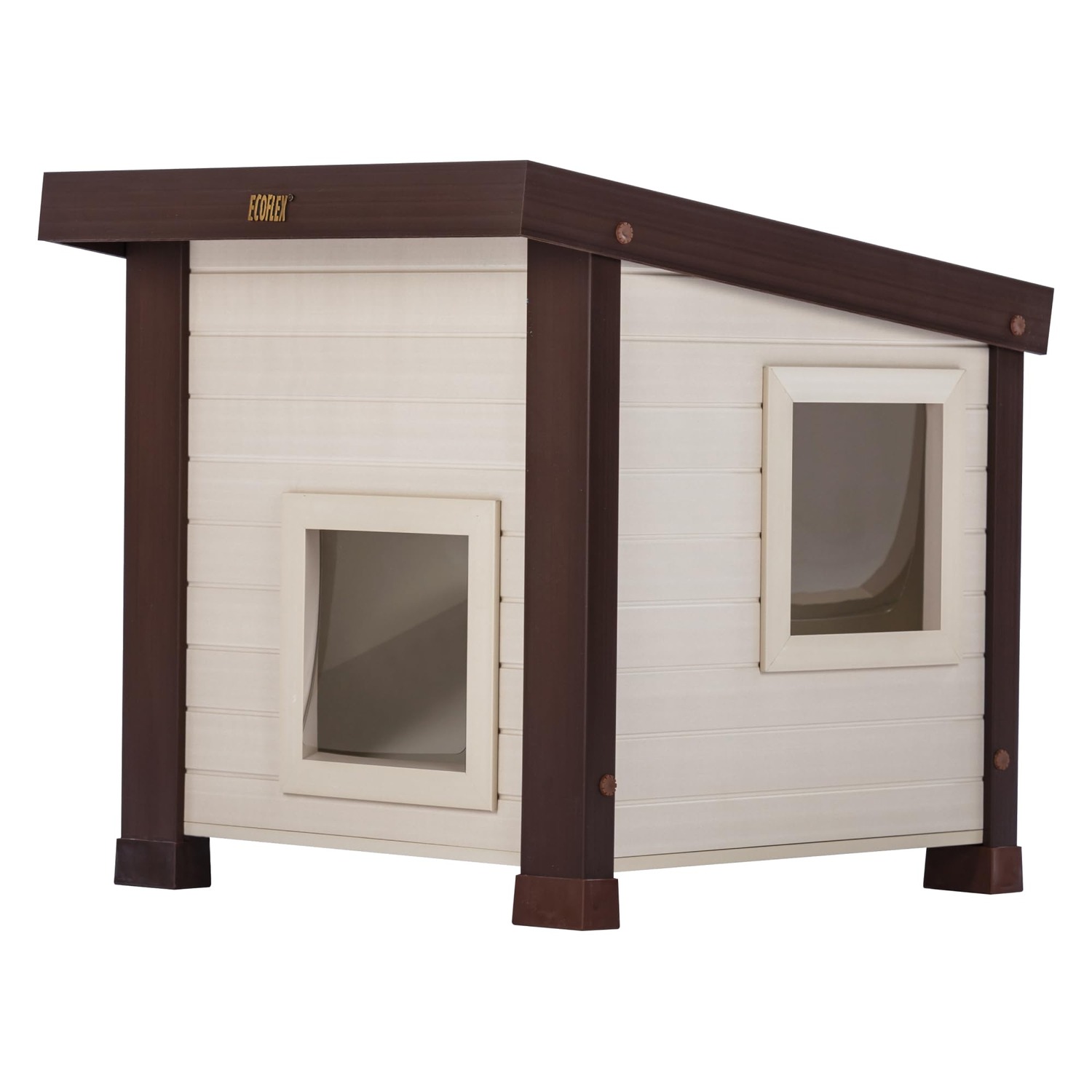
Then the openings. One door means a cat inside has a single way out, and a wary cat often will not go in at all. This shelter has two exits. Each has a clear plastic door flap, and the roof overhangs both doors.
The last thing is the floor. A removable cushioned floor pad comes with the house. A raised base is not listed, so on damp ground it helps to stand the house on something dry, like a board or a few pavers.
Who this suits
People with a cat that goes outside. Even a cat with a cat flap may use a sheltered spot on the stoep for the hours it is out.
Catio owners. Most catios have a roofed section. The house goes there as the sleeping corner.
Anyone feeding a shy or stray cat. Two exits and a quiet corner make it easier for a wary cat to try the house. Keep it in the same place.
Farm and plot households. The supplier lists a barn among the suggested spots. A yard cat that will not come indoors can still have a covered place of its own.
Two-cat homes. The supplier sizes this extra-wide house for two cats or one large cat.
It is less suited to an open lawn with no cover, or to anyone looking for a heated shelter.
Working out whether it fits
The house is 67.3 cm wide, 54.6 cm deep and 39.4 cm high. Those figures are measured including the roof overhang, so the room inside is smaller than the outside size suggests. Interior measurements are not listed.
Measure the spot first. A porch corner or the space under a deck needs to take the full width and depth, with room for a cat to walk up to both doors.
Then think about the cats. The supplier sizes the house for two cats or one large cat. Two cats that already pile up together on the couch will probably share. Two that keep their distance may take turns.
Weight is about 3 kg. One adult can lift it easily, which helps when you want to sweep under it or bring it in. It also means wind can shift it, so a sheltered position matters.
Setting it up properly
Assembly takes no tools. The walls join with hook-and-loop fasteners, and the roof lifts on. Then fit the door flaps and lay the floor pad inside. Press the fasteners together firmly along their whole length so the walls sit square.
For the position, follow the supplier's list: a porch, garage, barn or carport, under a deck, or indoors. Beyond that, a few habits help:
- Back it against a wall so one side is protected.
- Turn the doors away from the direction your weather usually comes from.
- Choose a corner people do not walk past all day.
- Keep both exits clear, so the second way out is a real one.
Then leave it alone. Put something that smells familiar inside and walk away. Cats look at new things on their own schedule.
If your cat will not push through the door flaps, take them off. Both are removable. Put them back once the cat is using the house.
Bedding and cold weather
The cushioned floor pad is the bedding that comes with the house, and many cats need nothing more.
In cold weather you can add a blanket on top of the pad, as long as the house is in a dry, covered spot. Check any bedding often. Damp bedding is cold bedding, so change it when it feels damp and not only when it looks dirty.
Remember that this house is unheated. If you decide to add a heat source of your own, that is a separate product with its own instructions, and this house has no electrics of its own.
Keeping it clean
No washing instructions are listed, so keep it simple. Lift out the floor pad and take off the door flaps. Shake out hair and grit. Wipe the surfaces with a damp cloth and a little mild soap, then let everything dry fully before the pad goes back.
Avoid strong-smelling cleaners. A cat that walks up to a house smelling of pine or citrus often turns around.
After a storm, check that the house has not shifted and that the ground under it is dry. If you are putting it away for a while, lift off the roof, undo the walls and fold it flat. Store it dry.
The short version
An unheated, soft-sided, insulated cat house in the extra-wide size: 67.3 cm wide, 54.6 cm deep and 39.4 cm high including the roof overhang, and about 3 kg. It has two exits with removable clear door flaps, a cushioned floor pad, and a water resistant polyester exterior in olive green with a black roof.
Put it under cover, back it against a wall and turn the doors away from the wind. Then let the cat make up its own mind.